Vijay Iyer: Solo (LP)
39,90 €
Formát:
LP
Dostupnosť:
na sklade / in stock
EAN kód:
0614427949714
Autori:
Vijay Iyer
Interpreti:
Vijay Iyer
Vydavateľ:
ACT
Zoznam skladieb
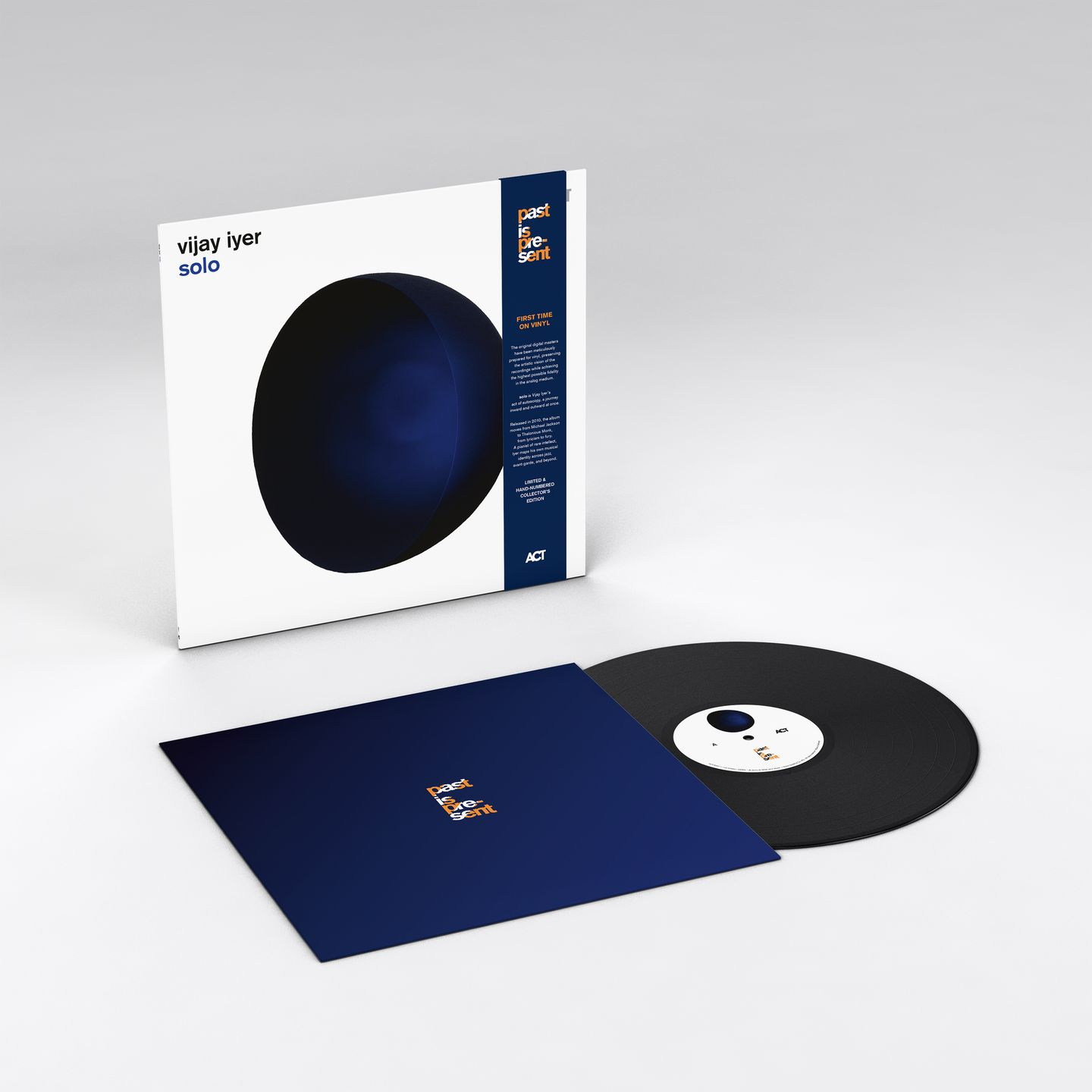
Vijay Iyer: Solo (Limited Handnumbered Edition LP) 180g black vinyl, lacquer disc cutting
Newly mastered for vinyl
New liner notes
Belly band made from premium art paper
Custom-designed labels and inner sleeves inspired by the original artwork
Limited to 1,000 copies & hand-numbered
tracks:
1
Human nature
Hörprobe Track 1: Human nature
2
Epistrophy
Hörprobe Track 2: Epistrophy
3
Darn that dream
Hörprobe Track 3: Darn that dream
4
Black & tan fantasy
Hörprobe Track 4: Black & tan fantasy
5
Prelude: Heartpiece
Hörprobe Track 5: Prelude: Heartpiece
6
Autoscopy
Hörprobe Track 6: Autoscopy
7
Patterns
Hörprobe Track 7: Patterns
8
Desiring
Hörprobe Track 8: Desiring
9
Games
Hörprobe Track 9: Games
10
Fleurette Africaine
Hörprobe Track 10: Fleurette Africaine
11
One for blount
Popis
There is no one who plays the piano quite like Vijay Iyer, indeed the term ‘pianist’ falls way short of doing him justice. Even the word ‘musician’ seems to tell only a part of his story. He was trained in classical and jazz music...but he also holds a degree in mathematics and physics and a PhD in cognitive musicology...and the professorial chair he holds at Harvard goes beyond music to span two departments. The New York Times has called him a “social conscience, multimedia collaborator, system builder, rhapsodist, historical thinker and multicultural gateway”. And yet Iyer’s creative paths always lead back to the piano: as a non-verbal means of expression for a penetrating intellect capable of encompassing, uniting and explaining a broad spectrum of disciplines, time periods and cultures.
Vijay Iyer’s aptly titled ACT label debut Historicity (2009) was the 14th album of his career, and yet it also marked his international breakthrough, receiving awards and accolades across genres: the New York Times chose it as Pop/Jazz Album of the Year, and DownBeat Magazine named The Vijay Iyer Trio with drummer Marcus Gilmore and bassist Stephan Crump as “Rising Star Jazz Group of the Year”. Alongside his wide range of influences, spanning from jazz to pop and hip-hop, and Vijay Iyer’s piano playing – at times it can be angular and rugged, at others hypnotically flowing and utterly distinctive – the album thrives in particular on the fascinating rhythmic complexity and a sense of interplay within the trio that has an uncanny elusiveness.
Given the magical way in which the members of this trio interact – it was to become Vijay Iyer’s main working band for the next few years – and Iyer’s highly collaborative approach, what came next was a surprising turn: his first solo album. Whereas it was ultimately released under a simple title, solo (2010), there had also been a working title, Autoscopy, a word which pinpoints the origins and the essence of this astonishing sequence of music. It is Iyer’s attempt, as he says, to view himself from the outside and to investigate how his musical identity was shaped by his personal influences, from Thelonious Monk, Andrew Hill, Duke Ellington, Muhal Richard Abrams, Randy Weston, Cecil Taylor and Sun Ra (Herman Blount), to contemporaries/collaborators such as Wadada Leo Smith, Steve Coleman and Roscoe Mitchell.
Solo is a unique and fascinating album full of contrast. What that means can be heard right from the start in Iyer’s heartfelt, deeply moving rendition of the Michael Jackson classic “Human Nature”. This version of the song, which is as powerful as it is utterly unpretentious, has gone on to become by far Iyer’s most-played track on digital platforms to this day. Without straying from the clarity and beauty of the opening track, Iyer immediately sets another tone completely, with the jagged, circling lines of his rendition of the avant-garde Thelonious Monk/Kenny Clarke classic “Epistrophy”. He then shifts direction once again, and fantasises on Eddie DeLange’s soulful 1939 standard “Darn That Dream”, with a deep understanding of its historical vocabulary.
It would be possible to pursue this narrative of contrasts and new departures right through to the end of the album. With every track, Vijay Iyer opens a fresh door into his musical cosmos: always surprising, often straddling past and present, from Duke Ellington to Steve Coleman, alongside his own multifaceted and infinitely engaging compositions and improvisations. From lyricicism to fury, from minimalism to opulence, from the irresistibly melodious to the jarringly atonal. And again and again we catch more than a glimmer of dry humour – to leaven the seriousness, the thoughtfulness, the genius that is Vijay Iyer.
It is well-nigh impossible to have enough of the rich tapestry of solo, with its countless facets and twists, and Vijay Iyer’s utterly unconventional piano style. This album always raises at least as many questions as it answers – it never ceases to reward repeated, deep immersion. As with all great albums in the history of recorded music, solo ultimately has the potential to transform its listeners as well, encouraging and enabling them to view music as a whole with fresh eyes. Solo is a timeless milestone of the kind that only the human mind and spirit is capable of producing.