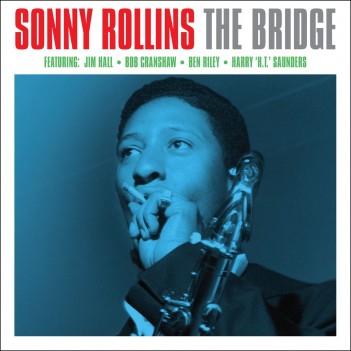
Sonny Rollins: The Bridge (LP)
22,00 €
Formát:
LP
Dostupnosť:
na sklade / in stock
Katalógové číslo:
350278
EAN kód:
8436563186059
Autori:
SONNY ROLLINS
Interpreti:
SONNY ROLLINS
Vydavateľ:
20TH CENTURY MASTER WORKS
Zoznam skladieb
Sonny Rollins: The Bridge (LP) colored blue vinyl1
Without A Song
2
Where Are You
3
John S.
4
God Bless The Child (alternative version)
5
The Bridge
6
God Bless The Child
7. You Do Something To Me
8. The Bridge (alternative versin)
Popis
Sonny Rollins, a born tenor saxophonist, is back. After two years of seclusion, the Rollins sound can now be enjoyed with even more power and style. His new partner, the famous guitarist Jim Hall, also played superbly and contributed to the giant's resurrection.
In the Fifties the two major exponents of the tenor saxophone were Rollins and John Coltrane, musicians whose styles were instantly recognisable and individuals destined to become role models for countless saxophonists for decades to come. Both had non-music issues to overcome in the earlier parts of their careers, and these they duly conquered to earn the respect of their peers.
As a teenager Rollins had no specific intention of becoming a working musician for he also showed promise as a painter.
Perhaps living in close proximity to the great Coleman Hawkins and the encouragement he received in working with trombonist JJ Johnson at the age of 18 determined the eventual path he took.
Thereafter he found himself in some pretty heavy company as he recorded with pianist Bud Powell alongside Fats Navarro, Tommy Potter and Roy Haynes, By this juncture he had already caught the ears of other committed modernists, leading to his entry into the Miles Davis group in 1951.
This was a difficult time for both the trumpeter and saxophonist, for both had become dependent on drugs, but Rollins’ few months with Miles did lead to him getting the chance to record under his own name for the Prestige label. A break from the recording scene of 12 months found him arrested for parole violation and, in a determined move to kick his habit, he started on a methadone programme, the first step to his getting clean.
When returning to the scene with renewed vigour, he picked up where he had left off, playing in Thelonious Monk’s group, recording again with Miles and performing with the fledgling Modern Jazz Quartet, a fleetingly successful marriage. He had become an impressive improviser, the equal of most of those around him, the only problem being his lack of consistency.
In 1955, Rollins took time out to re-evaluate his approach to his craft, finally re-emerging in December to record for Prestige the first of a series of albums remarkable for their quality and consistency. In a relatively short space of time the saxophonist also found himself as a member of the Clifford Brown-Max Roach quintet, regarded as one of the cutting-edge groups of the day. Tragically, the combination of Rollins and the mercurial trumpeter Brown as a front-line had little time to run, for Brown, along with pianist Richie Powell, was killed in a car accident in June 1956.
Whilst spending time in the quintet, Rollins continued to produce albums under his own steam such as ‘Saxophone Colossus’ and ‘Tenor Madness’. But just when he had undoubtedly established himself as a major voice he decided it was time for another reappraisal, virtually making himself redundant between 1959 and 1961. The only chance the jazz public would get to hear Rollins in person during that time would be if they happened to be travelling over New York’s Williamsburg Bridge in the early hours of the morning, where they could come across the saxophonist at his chosen location for practice.
From Rollins’ point of view this was viewed as a natural break, enabling him to re-charge his batteries, trying out ideas away from the unforgiving bandstand and deciding if he wished to change direction at a time when freely improvised music had started to make inroads into the jazz scene. But what he offered on what might be termed his ‘second coming’ was essentially more of the same inspired creativity, despite certain critics suggesting otherwise.
Comeback album ‘The Bridge’ from early 1962 had the normal Rollins balance of original and standard material, the surprise element being the inclusion of a guitarist rather than a pianist. Jim Hall would not have been an obvious choice to act as a foil for the bold, aggressive work associated with the saxophonist, but the commitment on both their parts to sophisticated harmonies turned the album into a triumph. Hall did make comment after the event to the effect that it was actually quite frightening to follow Rollins’ solos, and that there remained no doubt as to who the leader was.
Within two months, the same musicians were back with a percussion team in tow for the ‘What’s New? album, not perhaps as highly regarded as ‘The Bridge’ in terms of the Rollins discography but still a very worthy addition to his recorded repertoire of the time. There is a shifting of the personnel over the five tracks giving Rollins a chance to interact in different settings.
These two albums represent just a small stage of a particularly inspired musical journey – and Sonny Rollins has not stopped travelling yet.