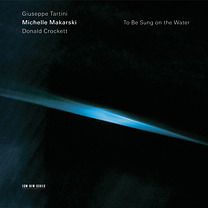
Makarski, Tartini, Crockett: To Be Sung on the Water
15,00 €
Formát:
CD
Dostupnosť:
7-14 dní
Katalógové číslo:
1871
EAN kód:
0028947631026
Autori:
Donald Crockett, Giuseppe Tartini
Interpreti:
Michelle Makarski, Ronald Copes
Vydavateľ:
ECM New Series
Zoznam skladieb
Giuseppe Tartini (1692–1770)Sonata IX A major
Largo andante
Allegro
Allegro assai
Menuet
Allegro
Donald Crockett (*1951)
to be sung on the water (1988)
Giuseppe Tartini
Sonata II d minor
Siciliana
Allegro
Allegro affetuoso
Donald Crockett
mickey finn (1996)
Giuseppe Tartini
Sonata XIII b minor
Andante
Allegro assai
Giga. Allegro affettuoso
Recorded Mach 2004
Popis
When Michelle Makarski’s last ECM-album Elogio per un’ombra was released six years ago, international critics were full of praise both for the performances and the insightful programming. “This beautifully recorded recital is one of the most compelling albums I have heard in a long time”, wrote Julian Haylock in The Strad. To be Sung on the Water can, in many ways, be seen as a sequel to Elogio, although the perspective now seems to be reversed: while the earlier recording focuses upon contemporary violin compositions mainly from Italy through the prism of Giuseppe Tartini, the new one intersperses three Tartini sonatas with pieces by American composer Donald Crockett written for Makarski in 1988 and 1996 respectively.
In his “Piccole Sonate” for unaccompanied violin, Giuseppe Tartini displays a more introverted character than could be expected from his most widely known work, the “Devil’s Trill” sonata which is marked by fiery technical display and surrounded by legends of a diabolical inspiration, legends that Tartini himself, as a good business man, was keen to spread. The 26 “Piccole Sonate” though, dating from the late period of his life bear all the hallmarks of a mature style. Outward virtuosity is reduced in favour of a compressed and refined expressivity. “These pieces are very rarely performed at all and I actually discovered them by chance”, says Makarski, whose skills in rendering a pure, light sound and subtle phrasing ideally suit this repertoire.
“I was very happy that after I had included the seventh sonata in the Elogio-album there was the possibility to record some more of them. When I started looking closely at the collection as a whole the three particular pieces I’ve chosen here jumped out as favourites. It’s very declamatory and heartfelt music, so seemingly simple but very moving…and so demanding! In a way more demanding than some pyrotechnical-sounding repertoire. Some movements are almost entirely monophonic and most of it is very transparent; it would be easy to vulgarize it by being heavy-handed.”
Just “for convention’s sake”, as he wrote in a letter, Tartini added fragmentary optional continuo parts for some of his “Piccole Sonate”, both to make life easier for violinists having trouble with the double stops and to meet the more “gallant” taste of the mid 18th century when unaccompanied violin music had become outmoded. Makarski, however, plays the solo versions. While she uses different bows in Tartini and Crockett, a Baroque bow and a historically set-up instrument with gut strings were never an option for her. “I’m not trying to be a specialist in any particular performance practice; I feel that I can be as true to what Tartini would appreciate without making these changes as long as I listen carefully and am informed about the period in general and its playing style. It took me years to find my own way with Bach, for example; years of listening, reading and practicing. But I always felt it had to happen organically, by itself and without its being imposed from the outside.”
Her versatility and openness to a very broad range of music is essential to Makarski’s approach to the violin repertoire as she has a strong predilection for carefully composed programmes juxtaposing early, lesser known and contemporary composition in a way that offers both lively contrasts and unexpected congruencies. “I didn’t want to include the piano in this recording. Crockett’s pieces came to my mind because I wanted to preserve the timbre of bowed strings. ‘To be sung on the water’ seemed to me like a modern equivalent to Tartini.” In fact there is a strong atmospheric connection between the pieces recorded here, most evident in the sequence of Crockett’s “To be sung on the water” for violin and viola (both muted throughout) and Tartini’s sonata in d minor which opens with a melancholic Siciliano full of poignant dissonances. As Steven Stucky points out in his liner notes, “Crockett grew up as a singer and lyrical melody, often combined with vigorous dance rhythms, is never far away in his music.”
Like Stephen Hartke whose works Makarski has recorded on two of her previous ECM-albums (“Caoine” on the record of the same title, released in 1997 and “Tituli” together with the Hilliard Ensemble, released last year), Donald Crockett is a longtime friend whose work and creative development Makarski has followed for many years. “I don’t feel I have to champion every contemporary composer, even if their music is good; it’s rather about personal temperaments. I’m not at all a compulsive listener because for me music is very potent; I have to take it in doses. I don’t know every piece Don Crockett has written but I have great respect for everything I’ve heard of his work and his wonderful writing for my instrument. I trust his artistic and personal integrity.”
…Tomorrow on shimmering wings time will again / slip away, as yesterday, as today,/
until on loftier, radiant pinions / I myself vanish from passing time
(from: Friedrich Leopold Graf zu Stolberg, “Auf dem Wasser zu singen” / “To be Sung on the water”, published in 1779)
٭٭٭
Michelle Makarski, American violinist of Polish and Italian descent, a native of northern Michigan, enjoys an international reputation performing a repertoire that ranges from early music to newly commissioned works and includes Baroque ornamentation as well as jazz improvisation. Makarski was winner of the Alberto Curci Competition in Naples and was awarded the Beethoven Sonata Prize at the Carl Flesch Competition in London. She was first prize winner at the Carnegie Hall International American Music Competition, an event that brought her to international attention. Her ECM-discography includes Bridge of Light with works by Keith Jarrett, Caoine, a collection of works for solo violin which won high international acclaim and the aforementioned Elogio per un’ombra. Her most recent appearance was on the Stephen Hartke album Tituli / Cathedral in the Thrashing Rain together with the Hilliard Ensemble. Michelle Makarski made a notable contribution to Polish jazz trumpeter Tomasz Stanko’s From The Green Hill alongside British saxophonist John Surman, Argentine bandoneonista Dino Saluzzi, Swedish bass player Anders Jormin and Norwegian drummer Jon Christensen.
Ronald Copes, born in Arkansas, was a member of the Dunsmuir Piano Quartet and the Los Angeles Piano Quartet before joining the Juilliard String Quartet as second violinist in 1997. Ronald Copes teaches at the Juilliard School of music.
CD package includes 12-page booklet with liner notes by American composer Steven Stucky, winner of the 2005 Pulitzer Prize in music.