
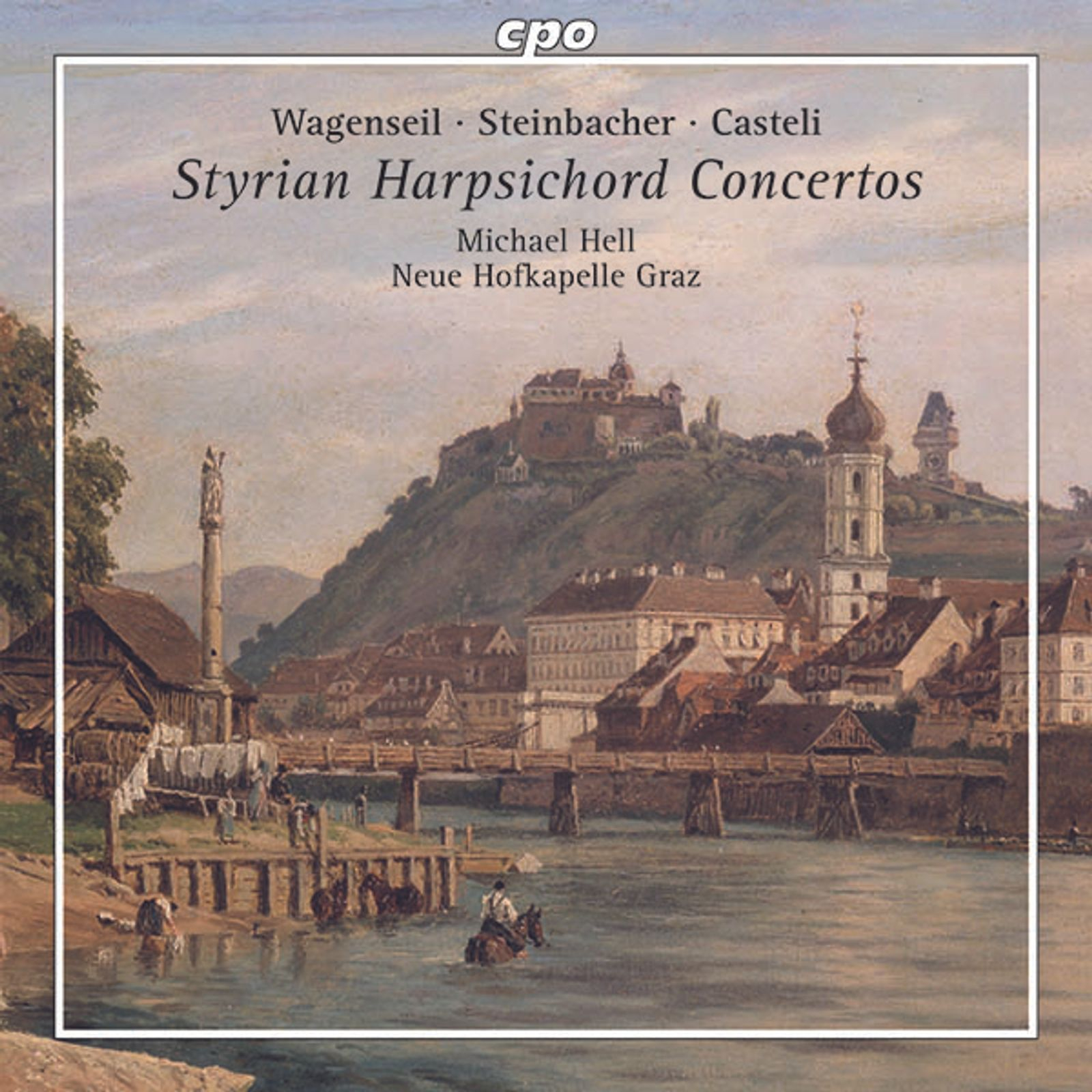
Styrian Harpsichord Concertos - Wagenseil, Steinbacher, Casteli
8,00 €
Formát:
CD
Dostupnosť:
backorder/ dodacia doba 7-14 dní
Katalógové číslo:
CPO 555269
EAN kód:
0761203526925
Autori:
Anonym., Casteli, Georg Christoph Wagenseil, Johann Adam Scheibl, Johann Michael Steinbacher
Interpreti:
Michael Hell, Neue Hofkapelle Graz
Vydavateľ:
CPO
Zoznam skladieb
Konzert für Cembalo und Streicher C-Dur1
Johann Adam Scheibl: 1. Allegro
2
Johann Adam Scheibl: 2. Larghetto
3
Johann Adam Scheibl: 3. Allegro
Konzert für Cembalo und Streicher g-moll
4
Georg Christoph Wagenseil: 1. Vivace
5
Georg Christoph Wagenseil: 2. Andante alla breve
6
Georg Christoph Wagenseil: 3. Allegro
7
Johann Michael Steinbacher: Pastorella G-Dur
Konzert für Cembalo und Streicher G-Dur
8
Casteli: 1. Allegro
9
Casteli: 2. Adagio
10
Casteli: 3. Presto
Konzert für Cembalo und Streicher C-Dur
11
Anonym: 1. Allegro
12
Anonym: 2. Adagio
13
Anonym: 3. Allegro
14
Johann Michael Steinbacher: Preludè für Cembalo a-moll
Konzert für Cembalo und Streicher a-moll
15
Johann Michael Steinbacher: 1. Allegro (Vivace)
16
Johann Michael Steinbacher: 2. Adagio (Andante)
17
Johann Michael Steinbacher: 3. Allegro
Konzert für Cembalo und Streicher F-Dur
18
Georg Christoph Wagenseil: 1. Allegro assai
19
Georg Christoph Wagenseil: 2. Adagio (Andante)
20
Georg Christoph Wagenseil: 3. Allegro assai
Popis
The term used to describe the epoch in which the works brought together on this album were composed is a matter of dispute. Did it come before the period of Viennese classicism, which means that it represents “pre-Classicism?” Or is it part of this period, that is, “Early Classicism?” The Austrian musicologist Rudolf Flotzinger came up with a pithy formulation for this phase of music history, terming it “the epoch between the epochs,” which means that it is no longer Baroque and not yet Classicism. During this period, in the middle of the eighteenth century and in the age of Empress Maria Theresa, the genres of instrumental ensemble music continuing even today to dominate the concert repertoire were developed – including the “clavier concerto,” which was performed in equal measure on the organ, on the harpsichord, and later on the pianoforte. The designation “clavier” current at that time merely generally referred to an instrument with claves (keys). A collection of clavier concertos extant in the Studies Library in Ptuj (Pettau), Slovenia, preserves the compositions recorded here in manuscript form. The harpsichordist Michael Hell, along with the Neue Hofkapelle Graz, led by him and Lucia Froihofer, performs these exciting works. Two highly outstanding instruments were available to Michael Hell for this recording: the harpsichord built by Johann Leydecker in Vienna in 1755, now freshly restored, and its copy built by Martin Pühringer in 2017. These instruments enable listeners to become acquainted with two instruments forming a perfect match for this repertoire: on an extremely well-preserved original instrument and on a copy that in its way is tonally just as suitable – after all, even during the time of its composition the music was performed on new instruments. The Ptuj collection shows how fragile and incomplete our knowledge of the musical practice from “the epoch between the epochs” really is. The transmitted manuscripts, above all the extant concertos by Wagenseil, document the variety of performance options, broad compositional palette, and widespread dissemination of music for keyboard instruments.